

Strengthening pathways to action for just and sustainable livestock systems.
CRILS is an inclusive network that brings together academics and civil society through a series of workshops.
Join us and share your ideas to further this critical agenda.


Why this network?
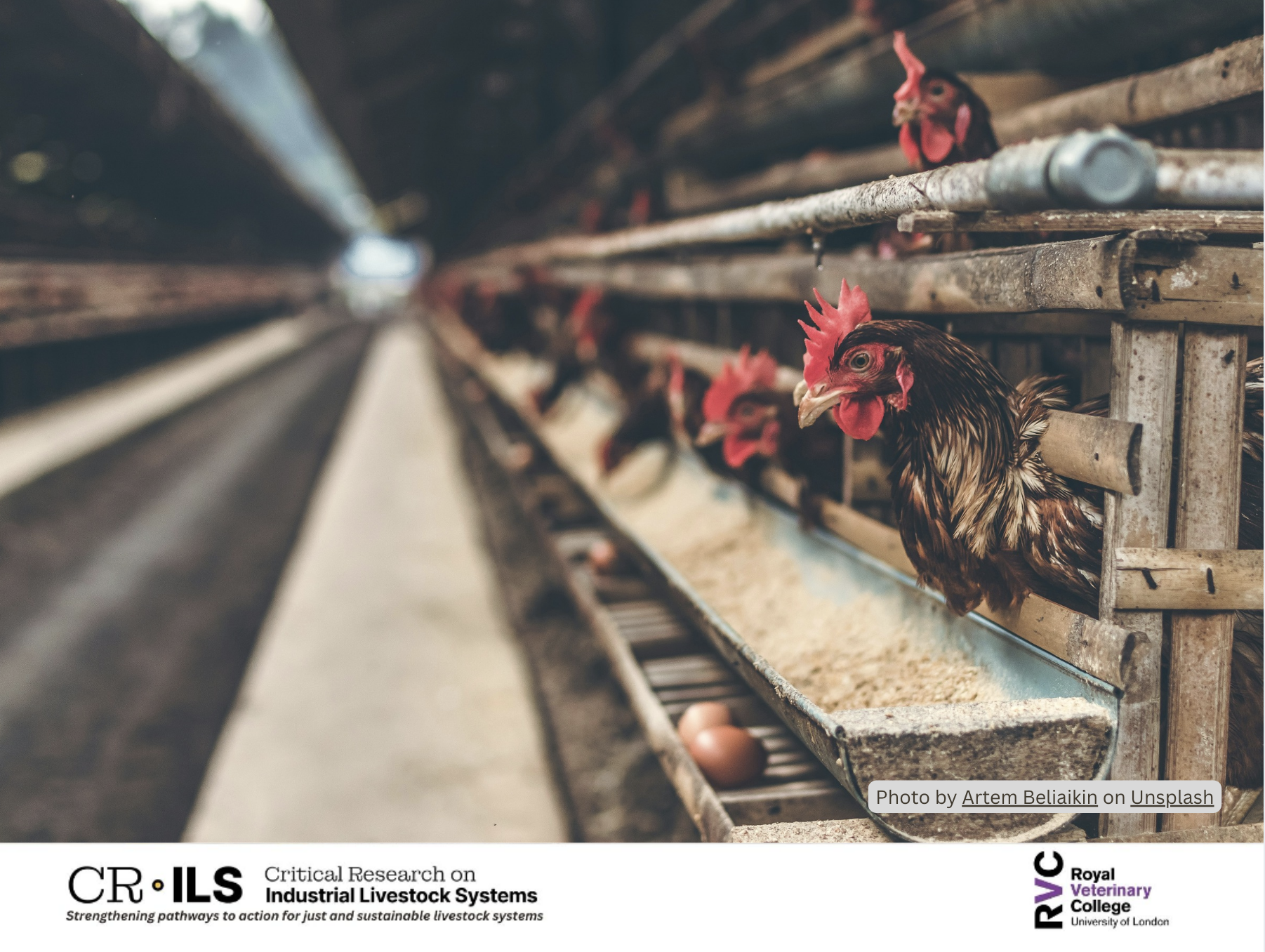
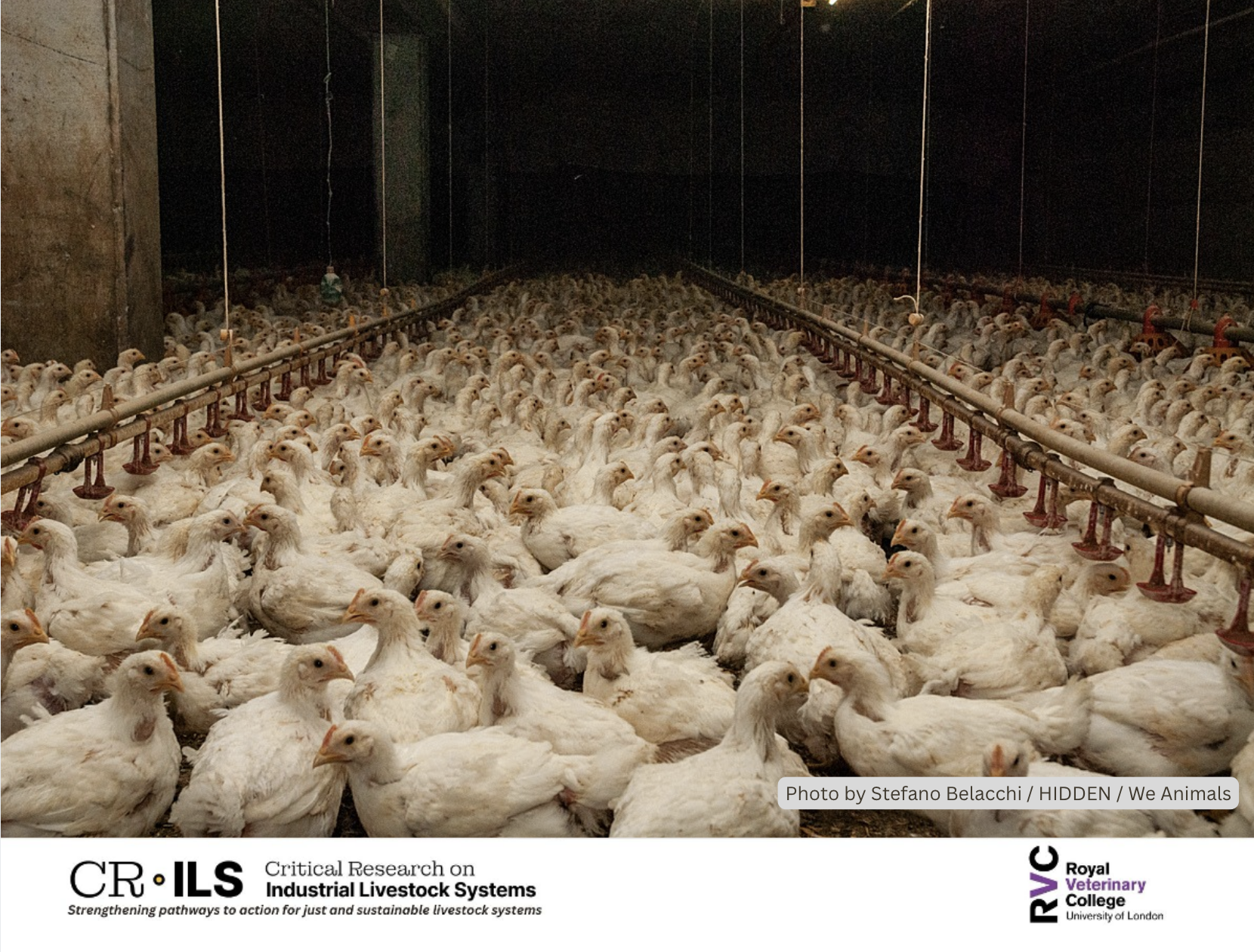
How livestock systems are governed and controlled matters because it shapes the food system. An industrial livestock system is characterised by low genetic diversity and, in some cases, high stocking density, vertical integration, and/or corporate consolidation. However, industrial farming has also boosted the availability of affordable and in-demand animal-sourced foods and advanced food security. Intensive systems are proposed as a solution to address animal-sourced food demand in a land-sparing manner, among some communities. But at what cost and for whom?
The externalities of industrialised livestock production systems may heighten vulnerability to pandemic threats, food insecurity and climate change. The burden of which can be higher in the Global South. Poorly considered industrialised systems can contribute to land dispossession, biodiversity loss, degraded animal welfare, poor working conditions, and the erosion of traditional and indigenous knowledge, among other effects.
The CRILS Network provides a platform to facilitate nuanced conversations on the impacts of industrial livestock production on our food systems.
If you’re interested in co-developing or sharing the network with other interested people, you can read more about ways of getting involved in the CRILS Network.


Our Goals
The Critical Research on Industrial Livestock Systems (CRILS) Network aims to understand the trade-offs of large-scale, industrial livestock systems and to use available evidence to advocate for just and sustainable food systems, especially in the Global South. The network brings together researchers and non-academics including civil society, activists, policy-makers, industry actors, and lawyers among others, to challenge and nuance narratives of livestock production systems.

Connect researchers
We aim to connect researchers in a supportive research environment to share ideas and disseminate research on improving or challenging industrial livestock systems. The network will platform early-career participants and participants from marginalised communities, and research conducted in Global South settings by local actors. We need nuanced and diversified knowledge bases to contribute to existing research narratives on industrialised animal agriculture.

Connect academics and frontline workers
Much of academic research remains within academic boundaries, behind paywalls and/or written in inaccessible and jargon-filled language. We aim to connect researchers with non-academic actors (lawyers, activists, campaigners, workers, journalists, industry professionals and community organisers) for bi-directional learning to improve the relevance and accessibility of research.

Strengthen pathways to actions
There is no single action or outcome that will transform livestock systems. Instead, the CRILS Network will provide a fertile ground to understand the processes and pathways towards improving action. In its current iteration, the CRILS Network aims to focus on research dissemination and connecting academic researchers and non-academic actors to improve research impact and develop evidence-based strategies for systems change.
Our Actions
How will we achieve these goals?
CRILS will run a series of interactive workshops online and in person to facilitate an open and organic space for researchers and change-makers to connect, cross-pollinate ideas, and share tactics. Additionally, we will provide support for developing skills in research dissemination.
CRILS is committed to ensuring this process is participatory and that the spaces and events we host are free of bigotry, oppression, and brutality in all forms.
Read our report to find out about CRILS activities in 2023-2024:
Learn more about our plans for CRILS 2025-2027:

In person at SOAS, London
Our in-person workshops consist of keynote talks, skill-building workshops, and open dialogues to further our understanding of and ability to use research for action. We are convening a diverse group of academics and practitioners whose work critically engages with industrial livestock systems.
Join our interactive online workshops to share and discuss your work
Online workshops
CRILS hosts a series of online workshops consisting of open discussions and training sessions to share skills and experiences of translating research into action. The workshops cross-pollinate ideas between academic and non-academic actors, enabling participants to strengthen their research practice. Sign up to our newsletter to be the first to hear about our upcoming workshops.
If you’re interested in co-organising an online workshop, please fill in this form, or email CRILSNetwork@soas.ac.uk with your ideas.
2026 Series
Upcoming Workshops
2 November 2026 | 10:00 AM - 12:00 PM GMT
Floating Factories: Corporate Power, Communities, and Aquatic Food Systems
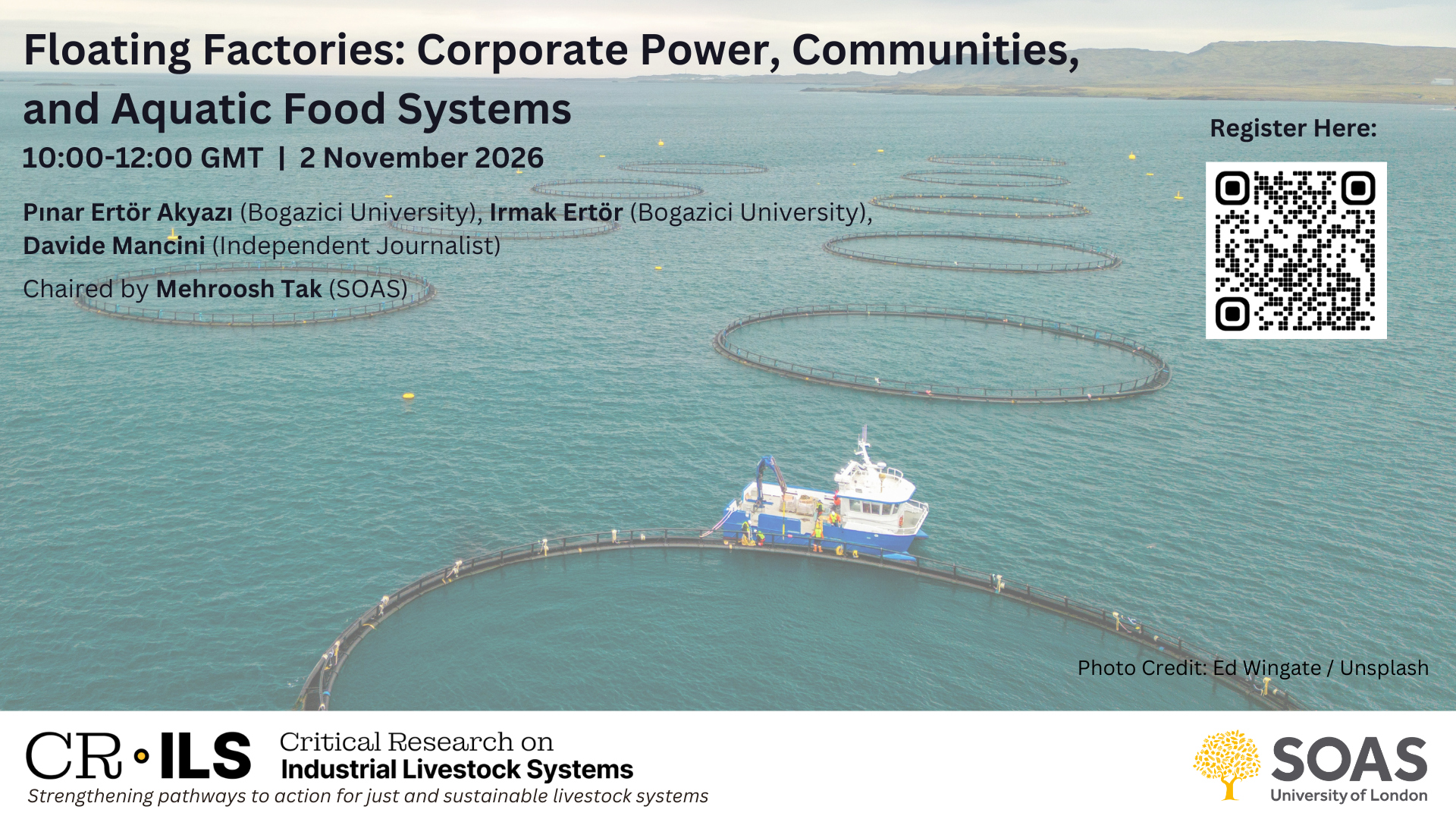
This workshop will examine the expansion of industrial sea bass and sea bream farming and its impact on local communities, ecologies and global food systems, particularly in Turkey and in West African countries like Guinea-Bissau and Mauritania. We will critically discuss aquaculture as a new commodity frontier, extracting fish from the shores of the Global South for incorporation into the fishmeal and fish oil industries, to highlight the contested livelihoods and ecological damage. Exploring production processes that evade traceability and accountability, the workshop will highlight the importance of alternative ecological frameworks such as Blue Justice to foreground the importance of local ecologies, diets, and labour conditions.
Speakers: Pınar Ertör Akyazı (Bogazici University), Irmak Ertör (Bogazici University), and Davide Mancini (Independent Journalist).
Chaired by: Mehroosh Tak (SOAS, University of London)
18 November 2026 | 09:00 AM - 11:00 AM GMT
“Do Fish Resist?” The Political Ecology of Industrial Fishing
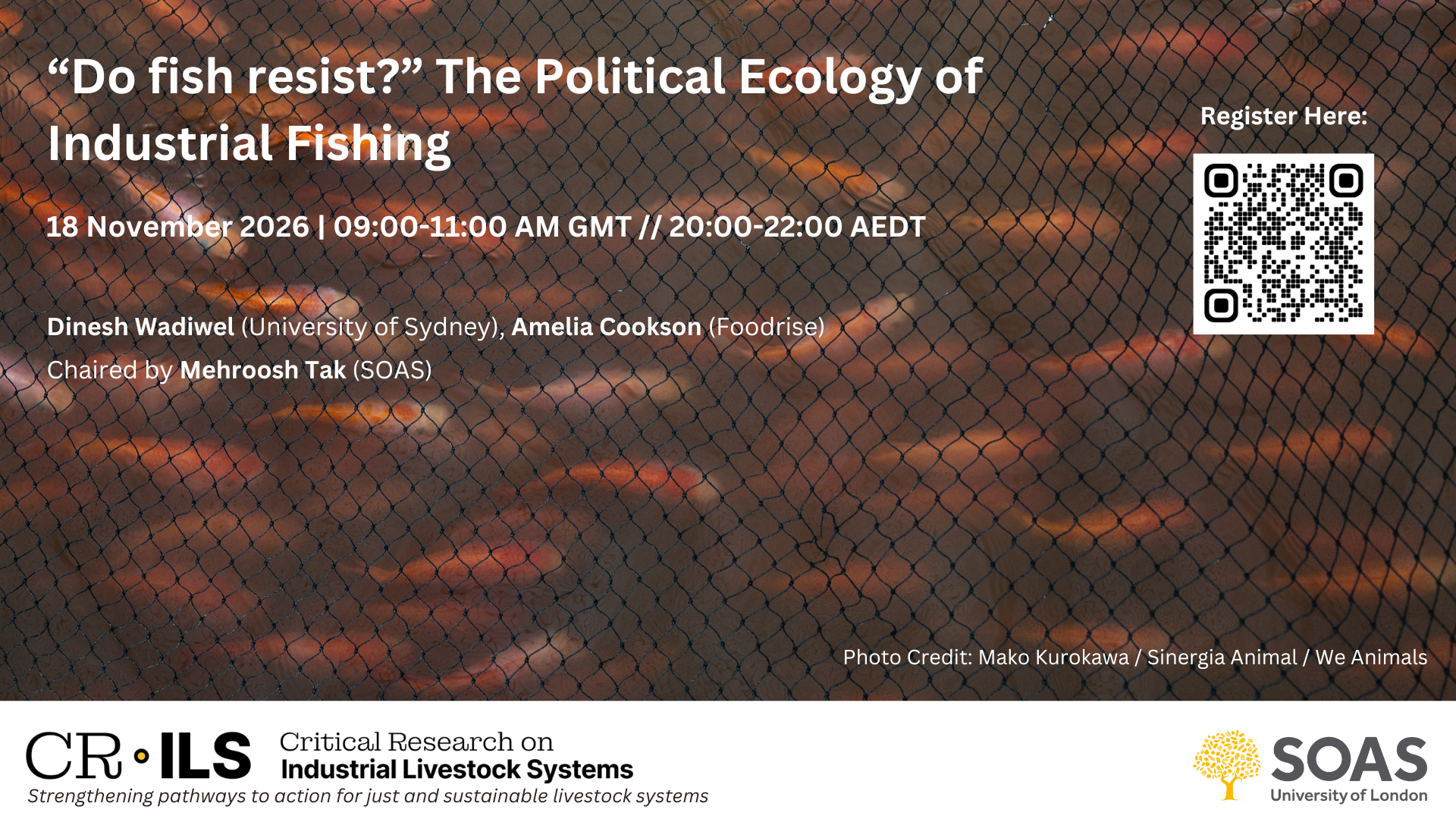
As industrial fishing systems adopt new technologies to provide fish for human consumption, critical perspectives on the implications of these technologies for animals, aquatic ecosystems, and, increasingly, terrestrial ecosystems become vital. How do fishing and farming technologies shape human relationships with fish, and what forms of harm might remain obscured by claims of sustainability? In this workshop, we will question the promises of technological innovation and sustainability by exploring the ecological costs of aquaculture for more-than-human ecologies.
Speakers: Dinesh Wadiwel (University of Sydney), Amelia Cookson (Foodrise)
Chaired by: Mehroosh Tak (SOAS, University of London)
9 December 2026 | 15:00 - 17:00 GMT
Rethinking One Health: Potentials, Tensions, and Limitations
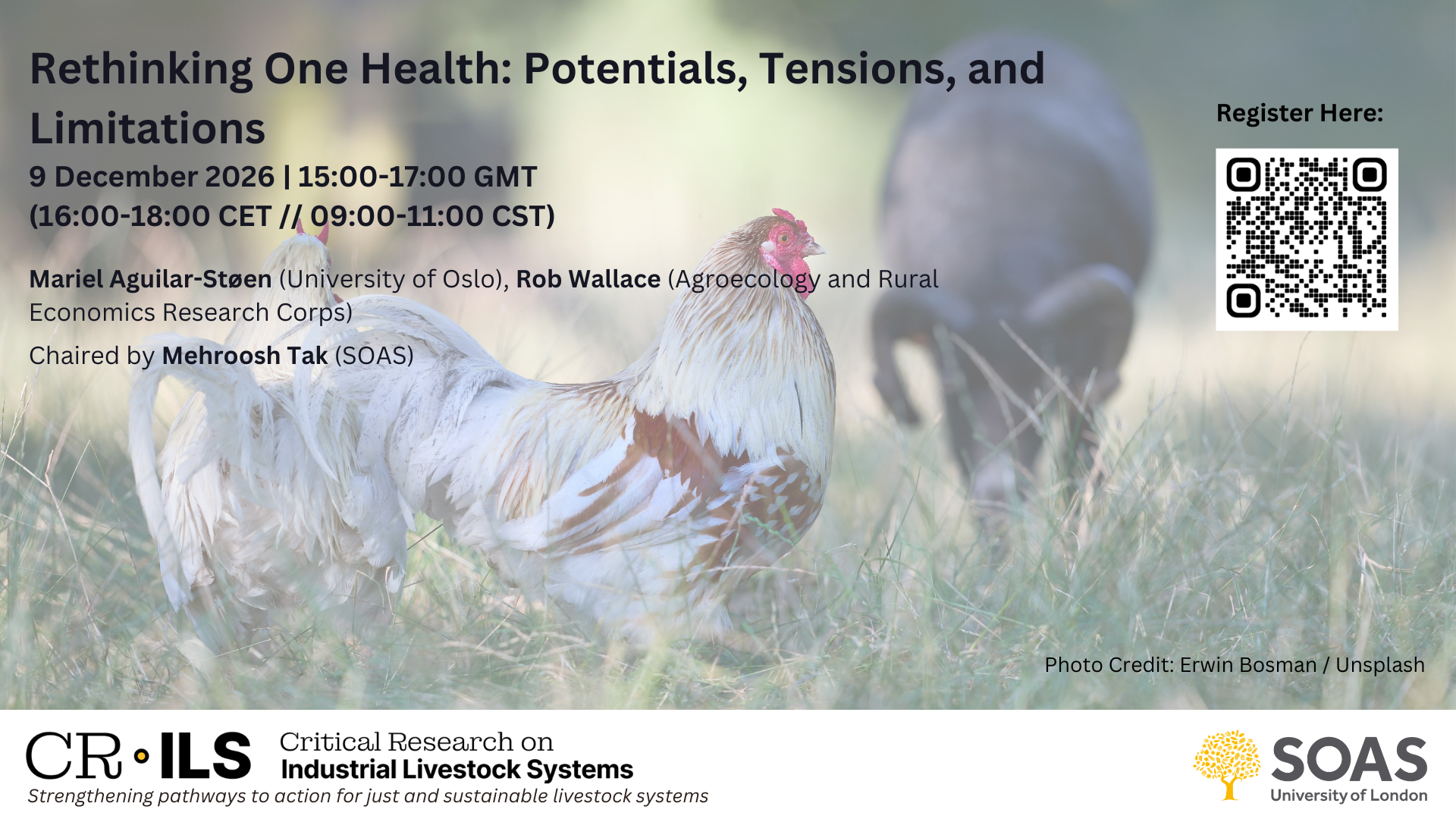
In this workshop, we will discuss the promises and limitations of the One Health framework for understanding the relationship between humans, other animals, and ecologies entangled in Industrial Livestock Systems. We aim to explore where One Health presents productive and critical analytical possibilities, alongside a discussion of its limitations, by moving beyond exclusively biomedical perspectives. The workshop will critically discuss how land use, agroecological change, and circuits of capital emerge as key dynamics for rethinking One Health as a framework attentive to the structural dynamics that lead to health crises.
Speakers: Rob Wallace (Agroecology and Rural Economics Research Corps), Mariel Aguilar-Støen (University of Oslo)
Chaired by: Mehroosh Tak (SOAS, University of London)
Past Workshops
October: Corporate Concentration in the Meat Industry: Market Power and Competition Policy
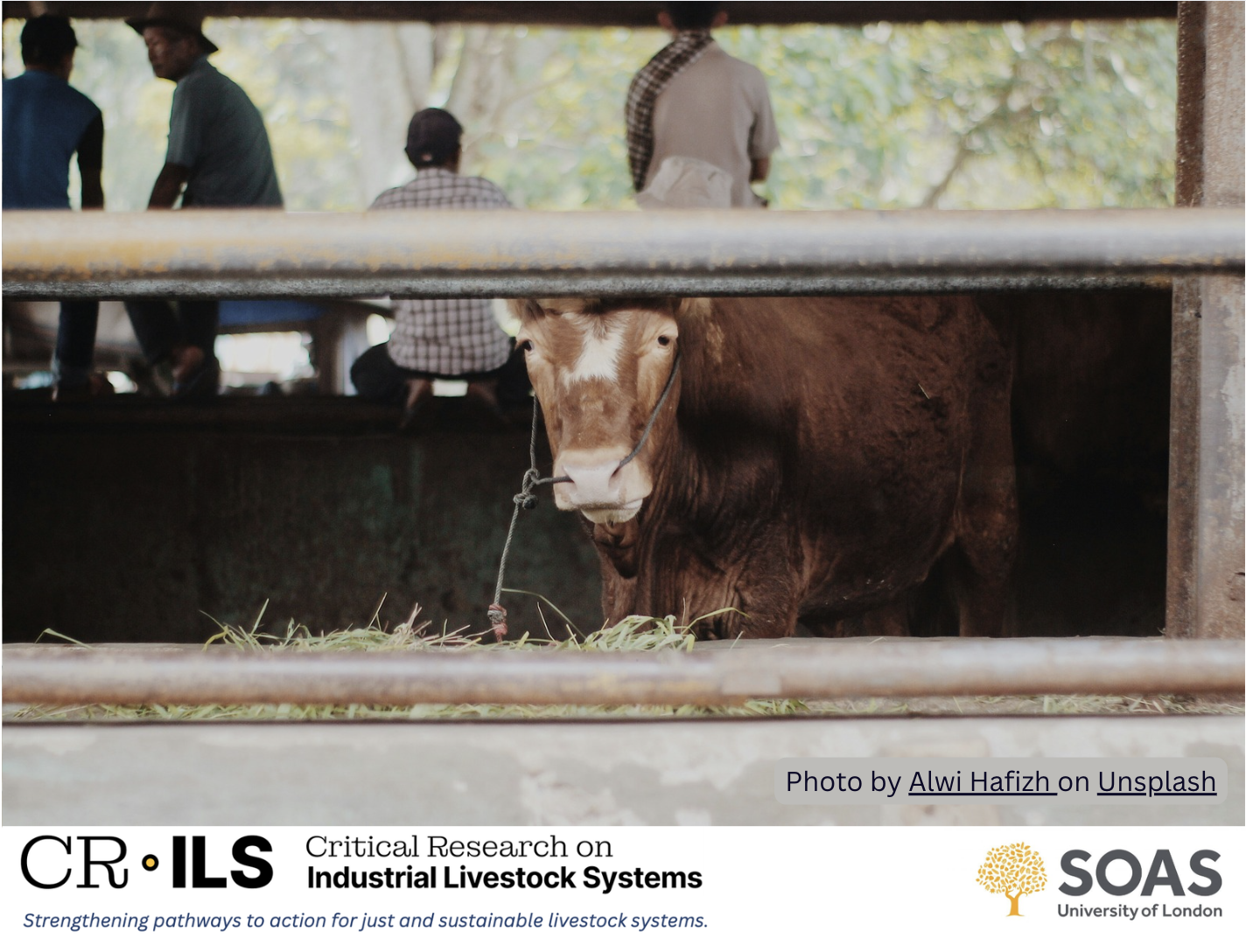
This workshop examined market monopolisation in cattle and poultry sectors in France and South Africa, highlighting both the importance and limitations of competition policy. Discussions connected market power to food sovereignty, rural livelihoods, One Health, and just food systems, emphasising the need for stronger cross-sector alliances and local networks.
Speakers: Margot Gibbs (Lighthouse Reports), Kagiso Zwane (Localisation Support Fund).
Chaired by: Mehroosh Tak (SOAS, University of London)
March: Mapping, Transparency, and Accountability on Concentrated
Animal Feeding Operations (CAFOs)
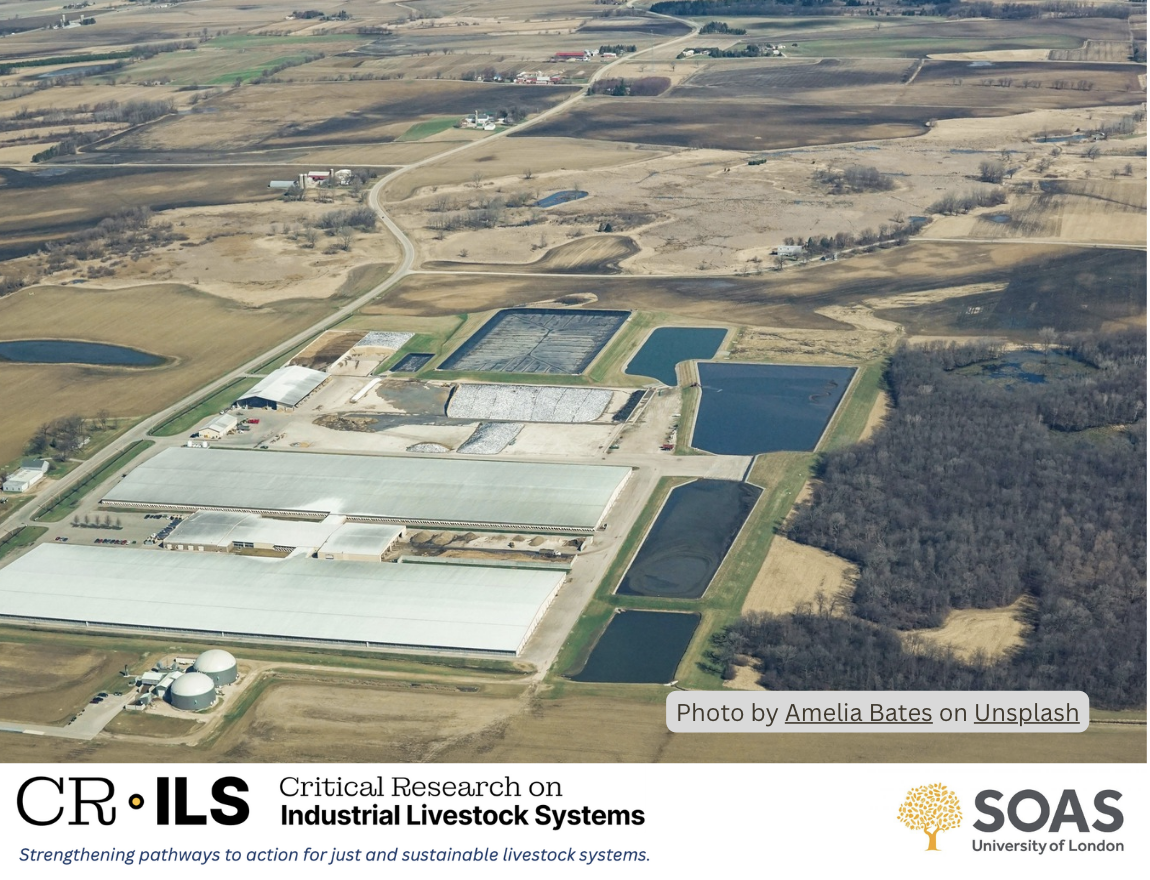
As industrial livestock systems expand across regions and sectors, the lack of publicly accessible data on CAFOs poses challenges for research, community advocacy, and regulatory oversight. This workshop examined how better-mapped CAFO data could strengthen accountability and enable communities to contest industrial animal agriculture's operations.
Speakers: Rachel Mason (Independent Researcher, Hawaii, USA) and Shady Heredia (CEDENMA & Stop Financing Factory Farming, Ecuador)
Chaired by: Mehroosh Tak (SOAS, University of London)
2025 Series
October: Inclusion and Competition in the Poultry Sector in Southern Africa
Grace Nsomba and Teboho Bosiu(Centre for Competition, Regulation and Economic Development, University of Johannesburg)
Arthur Odima (Competition Authority of Kenya)
Chaired by Mehroosh Tak (Royal Veterinary College)
June: Defend and Resist - Comparing Legal Approaches to Limit the Harms of Industrial Animal Agriculture in Mexico and the USA
Karen Hudlet Vazquez (Independent Researcher, Mexico)
Daina Bray (Law, Environment and Animals Programme, Yale University, USA)
Chaired by Alex Blanchette (Tufts University).
April: Southern Perspectives on Just Transitions from Industrial Livestock: Nigeria and South Africa
Andrew Bennie (Institute of Economic Justice, South Africa)
Opeyemi Elujulo (Youth in Agroecology Restoration Network, Nigeria)
Chaired by Sol Cuevas (Centro de Ciencias Humanas y Sociales, CSIC, Spain)
March: Livestock in Protracted Crises — Pressures of Industrialisation In Settler-Colonial And Conflict-Affected Areas
Dr Moayyad Bsharat (Union of Agricultural Work Committees (UAWC), Palestine)
Prof. Ian Scoones (Institute of Development Studies, University of Sussex)
Chaired by Prof. Lisa Boden (University of Edinburgh)
February: Feeding The World? Environmental Governance of Industrial Livestock's Appetite for Latin American Soy
Dr Paulina Flores Martinez (University of York, SEI-affiliated Researcher, UK)
Andrea Echeverri (Global Forest Coalition, Colombia).
Chaired by Helena Paul (EcoNexus, UK).
2024 Series
December: Art For Critical Research Practice: Unpacking Industrial Livestock Through Arts-Based Research
With Cooking Sections artist duo Alon Schwabe and Dr Daniel Fernández Pascual (School of Architecture, Royal College of Art), and Maya Marshak (Bio-economy Research, University of Cape Town). Chaired by Dr Andrew Bennie Senior Researcher in Climate Policy and Food Systems (Institute of Economic Justice, South Africa).
September: Biosecurity in context
Prof. Stephen Hinchliffe chaired this workshop with Prof. Nenene Qekwana (University of Pretoria), a vet and academic in South Africa, and Nathalia Brichet and Frida Hastrup (University of Copenhagen), social scientists in Denmark.
August: Ecolinguistics: language and human-animal relationships
This session was facilitated by Deniz Diler (PhD Candidate, University of Manchester), Topo Mokokwane (PhD Candidate, University of Manchester), and Samar Nasrullah Khan (PhD Candidate, Meertens Institute, and independent artist) and chaired by Zip Walton (RVC).
June: The Politics of Meat
Presentations from Jostein Jakobsen and Kenneth Bo Nielsen (University of Oslo) on their latest book Authoritarian Populism and Bovine Political Economy in Modi’s India and Sagari Ramdas (Food Sovereignty Alliance , India).
Facilitated by Mehroosh Tak (RVC).
May: Aquaculture: A new frontier in food colonialism
Presentations from Amelia Cookson (Campaigner, Feedback) and Dr Aliou Ba (Ocean Campaign Lead, Greenpeace Africa). Facilitated by Maria Garza (RVC).
February: Rethinking Animal Welfare
Co-organised by Prof. Christine Nicol (Royal Veterinary College), Judy Muriithi (Lawyers for Animal Protection, Africa) and Dr Victor Yamo (International Livestock Research Institute (ILRI)).
January: Global Capital and Big Livestock
Co-organised by Kezia Kershaw and Bianca Ines-Pedro (Stop Financing Factory Farming Campaign) and Mehroosh Tak (CRILS, RVC).